Guide•
15 min read
CSS Age Limit, Attempts & Eligibility Explained
Everything you need to know about age relaxation, attempts, and qualifications.
Nimra Javed
Author
2025-12-30
Published
CSS Age Limit, Attempts & Eligibility Explained: The Definitive 2026 Guide
Author: Nimra Javed
Date: December 30, 2025
Reading Time: 15 Minutes
Date: December 30, 2025
Reading Time: 15 Minutes
Introduction
The first step in your CSS journey is not buying a book; it is checking your ID card. Every year, hundreds of candidates prepare for months only to find out their application is rejected due to age or degree issues. The rules of the Federal Public Service Commission (FPSC) are rigid, binary, and unforgiving.
This guide provides a microscopic analysis of the eligibility criteria for CSS 2026, including the complex "Age Relaxation" rules that many candidates miss.
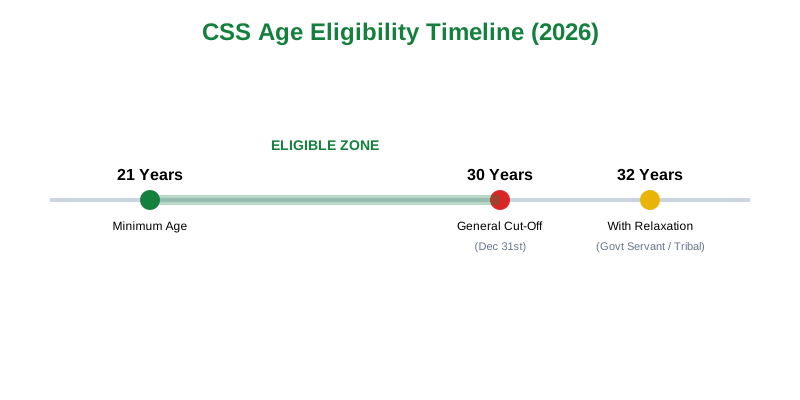
1. The Golden Rule: The Cut-Off Date
The most confusing part of CSS eligibility is the Cut-Off Date.
- Rule: Your age is calculated on 31st December of the year preceding the exam.
- For CSS 2026: The cut-off date is 31st December 2025.
The Math:
- You must be born on or before 31st December 2004 (Minimum 21 Years).
- You must be born on or after 31st December 1995 (Maximum 30 Years).
If you are born on 30th December 1995, you are 30 years and 1 day old on the cut-off date. You are INELIGIBLE.
If you are born on 1st January 1996, you are 29 years and 364 days old. You are ELIGIBLE.
2. Age Relaxation: Can you apply at 32?
Yes, but only under specific categories. The upper age limit is relaxed by 2 years (up to 32 years) for the following:
Category A: Government Servants
- Who: Employees of Federal, Provincial, or Armed Forces departments.
- Condition: You must have completed 2 years of continuous service as of the cut-off date.
- Proof: You need a Departmental Permission Certificate (DPC) and Service Certificate.
- Note: Contract employees are usually not eligible unless their service is regularized or the contract rules specify.
Category B: Scheduled Castes & Buddhist Community
- Who: Recognized scheduled castes (e.g., Hindu Dalits) and Buddhist community members.
- Proof: Certificate from the District Magistrate.
Category C: Recognized Tribes & Areas
- Who: Permanent residents of:
- Balochistan.
- Tribal Areas of D.I. Khan and Peshawar Divisions (Ex-FATA).
- Azad Jammu & Kashmir (AJK).
- Gilgit-Baltistan.
- Proof: Detailed Domicile Certificate.
- Why? To encourage representation from under-developed areas.
Category D: Special Needs
- Who: Candidates with permanent physical disabilities (Blindness, Hearing Impairment, etc.).
- Proof: Disability Certificate from a government medical board.
3. Education Criteria: The 14-Year Rule
- Minimum Degree: Bachelor's Degree (Class C or Grade C minimum).
- Years: 14 Years of education (e.g., B.A, B.Sc, B.Com) OR 16 Years (BS, MA, MSc, MBBS, BE).
- University: Must be HEC recognized.
Common Question: "I have a 3rd Division in BA, can I apply?"
- Taking a Master's: If you obtained a higher division (Grade A or B) in your Master's degree, it overrides the 3rd division in your Bachelor's. You become eligible.
Foreign Degrees
If you studied at Oxford, Harvard, or even a foreign affiliated college in Pakistan, you often get a GPA but no "Division."
- Solution: You MUST obtain an Equivalence Certificate from the HEC (Higher Education Commission) stating that your degree is equivalent to a Pakistani Bachelor's.
4. Number of Attempts: The "Three Strikes" Law
- Total Attempts: 3.
- Screening Test (MPT): Appearing in the MPT (Screening Test) does NOT count as a CSS attempt. You can fail MPT 10 times; it won't affect your written attempts.
- The Written Exam: The attempt is counted the moment you enter the exam hall and sign attendance for the first paper (usually English Essay).
- If you sit for Essay and then leave the rest of the papers -> Attempt Counted (Fail).
- If you apply but do not sit for any paper -> Attempt NOT Counted.
5. Medical & Psychological Eligibility
Passing the written exam is not the end.
- Physical: You must meet height/chest measurements (for Police group) and general health standards (eyesight, BMI).
- Psychological: There is a psychometric assessment. If the panel deems you "Unfit for Government Service" (e.g., extreme radical views, emotional instability), you will be rejected regardless of your written score.
Conclusion
The eligibility rules are a filter. They are designed to ensure that candidates entering the service have a certain level of maturity and education. Before you start your preparation, spend one day gathering your documents (Matric, Inter, Degree, Domicile). Check the dates. A rejection letter from FPSC after qualifying the written exam is a heartbreak you want to avoid.
If you are eligible, don't wait. Learn how to prepare on your own: Guide to Self-Study.
About Nimra Javed
Specialist in Civil Services preparation and policy analysis. Dedicated to democratizing education for all Pakistani aspirants via cssguided.com.