Governance•
15 min read
Role of CSS Officers in Pakistan’s Governance
Understanding the backbone of the state: Policy-making, administration, and impact.
Dr. Kamran Ilyas
Author
2025-12-31
Published
Role of CSS Officers in Pakistan’s Governance: A Deep Dive
Author: Dr. Kamran Ilyas
Date: December 31, 2025
Reading Time: 18 Minutes
Date: December 31, 2025
Reading Time: 18 Minutes
Introduction
In the intricate tapestry of Pakistan's statehood, politicians are the weavers who design the pattern, but the Civil Servants are the threads that hold it together. The role of a Central Superior Services (CSS) officer is often shrouded in mystery, aura, and misconceptions of "power." To the common man, a CSP officer is a figure of authority in a flagged car. To the state, they are the permanent executive.
This comprehensive article analyzes the functional, structural, and social role of CSS officers in the governance of Pakistan. We will move beyond the superficial "glamour" and explore the hard realities of policy-making, district administration, and crisis management.
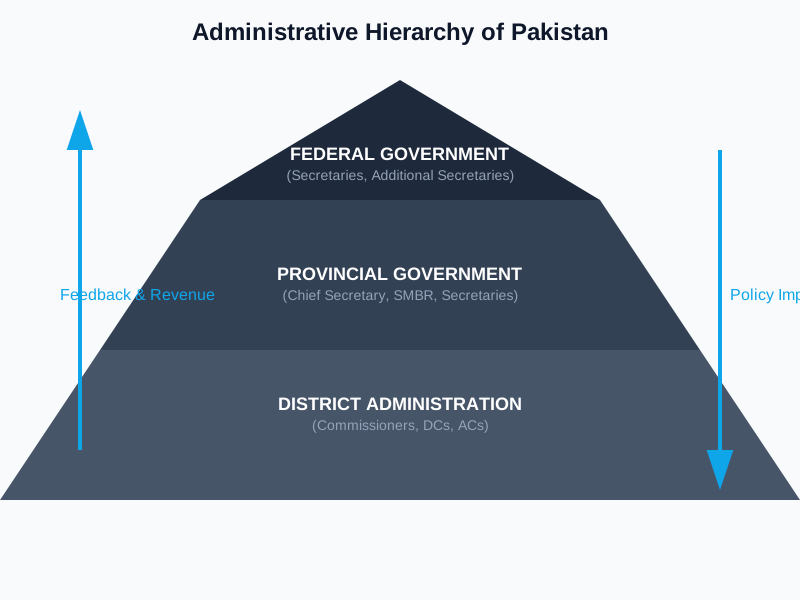
1. The Structure of Governance: Secretariat vs. Field
To understand the role of a CSP officer, one must understand the dichotomy of the Pakistani administrative system: the Secretariat and the Field.
A. The Civil Secretariat (The Brain)
The Secretariat (Federal in Islamabad, Provincial in Lahore/Karachi/etc.) is where policies are born. Officers here (Section Officers, Deputy Secretaries, Additional Secretaries) do not deal with the public directly. They deal with files, laws, and budgets.
- Policy Formulation: When the government decides to launch a "Health Card," it is the Secretariat officers who draft the PC-1 (Project Concept), calculate the budget, draft the legal framework, and get it approved by the Cabinet.
- Coordination: The Secretariat ensures that the Education Department is talking to the Finance Department. Without this coordination, schools would be built without teachers being paid.
B. The Field Administration (The Hands)
This is the face of the government. The Commissioner, Deputy Commissioner (DC), and Assistant Commissioner (AC) represent the state on the ground.
- Implementation: If the Secretariat sends a notification to "Close markets at 8 PM," the AC is the one walking the streets with police to ensure shutters are down.
- Service Delivery: From issuing domicile certificates to maintaining land records (Patwar), the field formation delivers services directly to the citizen.
2. The Deputy Commissioner (DC): The Linchpin
The office of the Deputy Commissioner is a relic of the British Raj, yet it remains the most critical post in Pakistan's governance. The DC wears three hats:
- District Magistrate (DM): Although judicial powers were separated, the DC retains powers under Section 144 CrPC (banning assemblies), 16 MPO (detaining public order threats), and price control magistracy. They are responsible for Law & Order.
- Collector: As the head of revenue, the DC oversees land registration, tax collection, and land acquisition for state projects.
- Deputy Commissioner: The coordinator of all government departments in the district (Health, Education, Works). If a hospital has no medicine, the DC is expected to intervene.
A Day in the Life of a DC
- 09:00 AM: Meet with public delegators (open court).
- 11:00 AM: Meeting with District Health Officer regarding Dengue prevention.
- 01:00 PM: Site visit to a under-construction road to check quality.
- 04:00 PM: Security meeting with DPO (District Police Officer) for an upcoming religious procession.
- 10:00 PM: Surprise visit to the District Headquarter Hospital.
3. Policy Making: The unseen Impact
The public rarely sees the work done in the Secretariat, but it affects their lives for decades.
-
Case Study: The Single National Curriculum (SNC) This massive reform was not just a political slogan. It required hundreds of CSP officers in the Ministry of Federal Education to sit with provinces, religious seminaries (Madrassas), and private schools to draft a unified syllabus. The negotiations, the legal drafts, and the implementation framework were all bureaucratic legwork.
-
Case Study: The Motorway Police The creation of the NHMP (National Highways & Motorway Police) is a prime example of bureaucratic excellence. A CSP officer, Afzal Ali Shigri, designed a force with a new culture—honest, polite, and well-paid. Today, it is one of the few respected institutions in the country.
4. Crisis Management: The First Line of Defense
When disaster strikes, the bureaucracy is the first responder.
- Floods 2022: While NGOs and International aid came later, the immediate rescue—using boats to save villagers, setting up tent cities, and diverting floodwaters—was managed by local ACs and DCs. They stayed awake for days, coordinating with the Army and NDMA.
- COVID-19: The NCOC (National Command and Operation Center) was a hybrid civil-military bureaucratic body. CSP officers tracked data, enforced lockdowns, and managed oxygen supplies, preventing a total healthcare collapse.
5. Challenges Facing the Service
It is not all smooth sailing. The role of CSS officers is under immense pressure in 2026.
- Politicization: Tenure insecurity is a major issue. Officers who refuse illegal orders are often made "OSD" (Officer on Special Duty) or transferred to remote areas.
- Capacity Issues: The problems of the 21st century (Climate Change, Cyber Warfare, Artificial Intelligence) require specialized knowledge. The "Generalist" nature of the PAS group is being challenged by the need for technocrats.
- Public Trust: The colonial hangover of "Sahib" culture isolates officers from the public. The new generation of officers is trying to break this by being accessible on social media and open courts, but the trust deficit remains.
Conclusion
The role of a CSS officer is paradoxical. They are powerful yet vulnerable; they are rulers yet servants. Ultimately, they are the permanent software running the hardware of the state. For broad macro-economic stability or for the justice of a poor widow in a village court, the pen of a Civil Servant is the most potent tool in Pakistan.
To join this service is to accept a burden. It is a pledge to serve the Constitution and the people, often at the cost of personal peace. It is not just a job; it is a national duty.
Ready to check if you qualify? Read our guide on Age Limits & Eligibility.
About Dr. Kamran Ilyas
Specialist in Civil Services preparation and policy analysis. Dedicated to democratizing education for all Pakistani aspirants via cssguided.com.